

Learning at home
Learning how to learn in the age of AI
We shared NoTuition.in with ten families for two weeks. Eight parents said their child preferred doing the labs and worksheets on it. Here is what we think that says about a skill that matters more every year: learning how to learn.
Ten families, two weeks
This month we shared NoTuition.in with ten parents. Their children used the learning labs and worksheets at home for about two weeks, and the parents told us what worked and what got in the way.
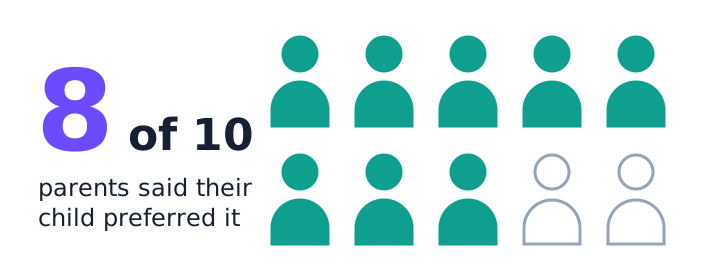
At the end of those two weeks, eight of the ten parents said the same thing: their child preferred doing the labs and worksheets on NoTuition.in.
For a small team that builds practice tools, that is the result you hope for and do not quite expect. So this post is less about the number and more about why we think it happened, because the reason is bigger than one app. Our view is that the children were practising the act of learning itself, not only the answers. In a world where a phone can produce the answer, that is the part that counts.
Marks still matter. They are just not enough any more
Every parent we know cares about marks, and so do we. School exams are real, and a good score opens doors. But much of what a typical score measures is whether a child can produce the right answer to a question they were prepared for.
AI apps have become very good at producing answers. A child can photograph a maths sum or type a question about photosynthesis and get a neat, finished answer in seconds. A finished answer on a screen does not show that the child understands it, and if school practice builds only the ability to reproduce known answers, a phone can now do much of that.
What no app can do for your child is the learning itself. Noticing that something does not make sense. Trying an idea. Checking it. Working out why it went wrong. Then picking up the next new thing a little faster than the last one. That is what people mean by learning how to learn, and unlike a chapter, it does not go out of date.
Employers are saying something similar. The World Economic Forum's Future of Jobs Report 2025 found that, on average, workers can expect two-fifths (39%) of their existing skill sets to be transformed or become outdated between 2025 and 2030. Analytical thinking is still the skill employers want most, with seven out of 10 companies calling it essential, and curiosity and lifelong learning are among the skills expected to keep rising in importance. Our children will grow up into that world. The habit of learning something new, quickly and properly, is worth more to them than any single chapter.
India's own education policy says it plainly. This is from the introduction to the National Education Policy 2020:
"...it is becoming increasingly critical that children not only learn, but more importantly learn how to learn. Education thus, must move towards less content, and more towards learning about how to think critically and solve problems, how to be creative and multidisciplinary, and how to innovate, adapt, and absorb new material in novel and changing fields."
What learning how to learn looks like in a school child
It sounds abstract, but in a child it shows up as a handful of small habits you can actually see:
- They try something before waiting to be told how.
- They check their own answer instead of asking you "Is this right?"
- When they get it wrong, they want to know why.
- They come back to a topic a few days later and it is still there.
- They can handle the question when it is asked a different way.
None of these are personality traits. They are habits, and habits come from repetition. A child who goes round this loop a few times a week, fifteen or twenty minutes at a time, tends to get better at it, the same way time at the nets makes a better batter.
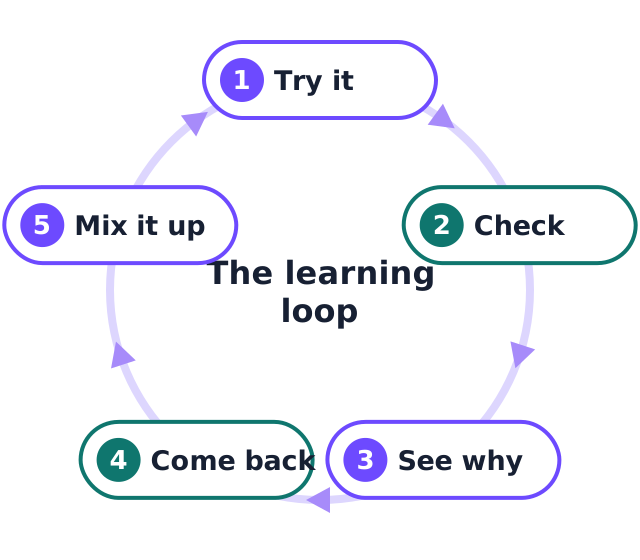
Here is how each step works on NoTuition.in.
1. Try it first: learning labs
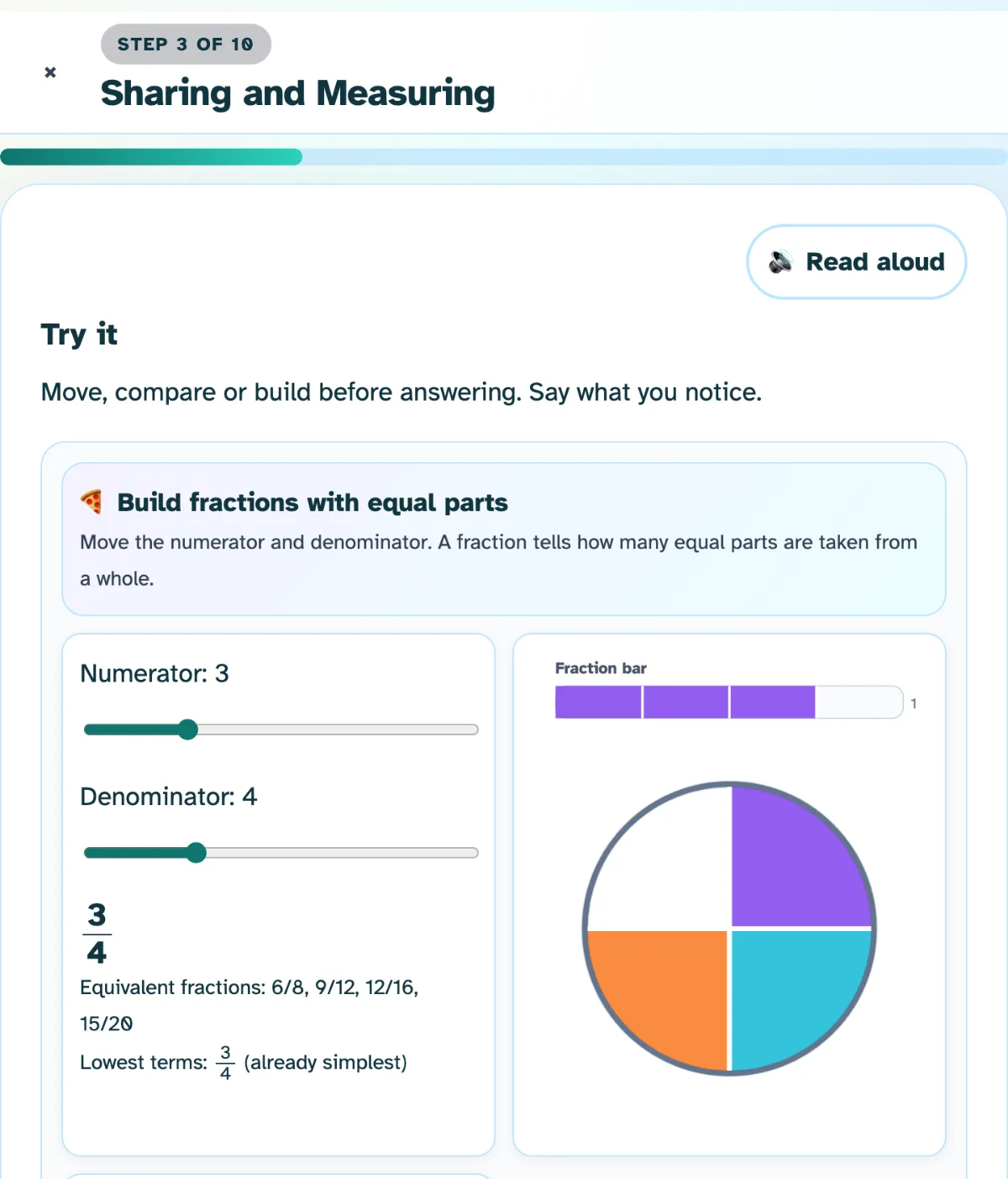
A chapter starts with a lab where the child moves, builds or compares something before answering any questions. In the Class 4 maths chapter Sharing and Measuring, the fraction lab lets the child set the top and bottom numbers of a fraction, then shows it as a bar and as a pie, along with fractions that are equal to it. The instruction at the top is short: "Move, compare or build before answering. Say what you notice."
That last line does a lot of work. A child who has set three quarters, changed it to two quarters and watched the bar match exactly half of the whole does not need to memorise that 2/4 is the same as 1/2. They have seen it happen. The new NCERT books are full of activities like this, and a lab lets a child do them alone at home, without a parent cutting paper strips at nine at night.
2. Check, and see why: practice that explains every mistake
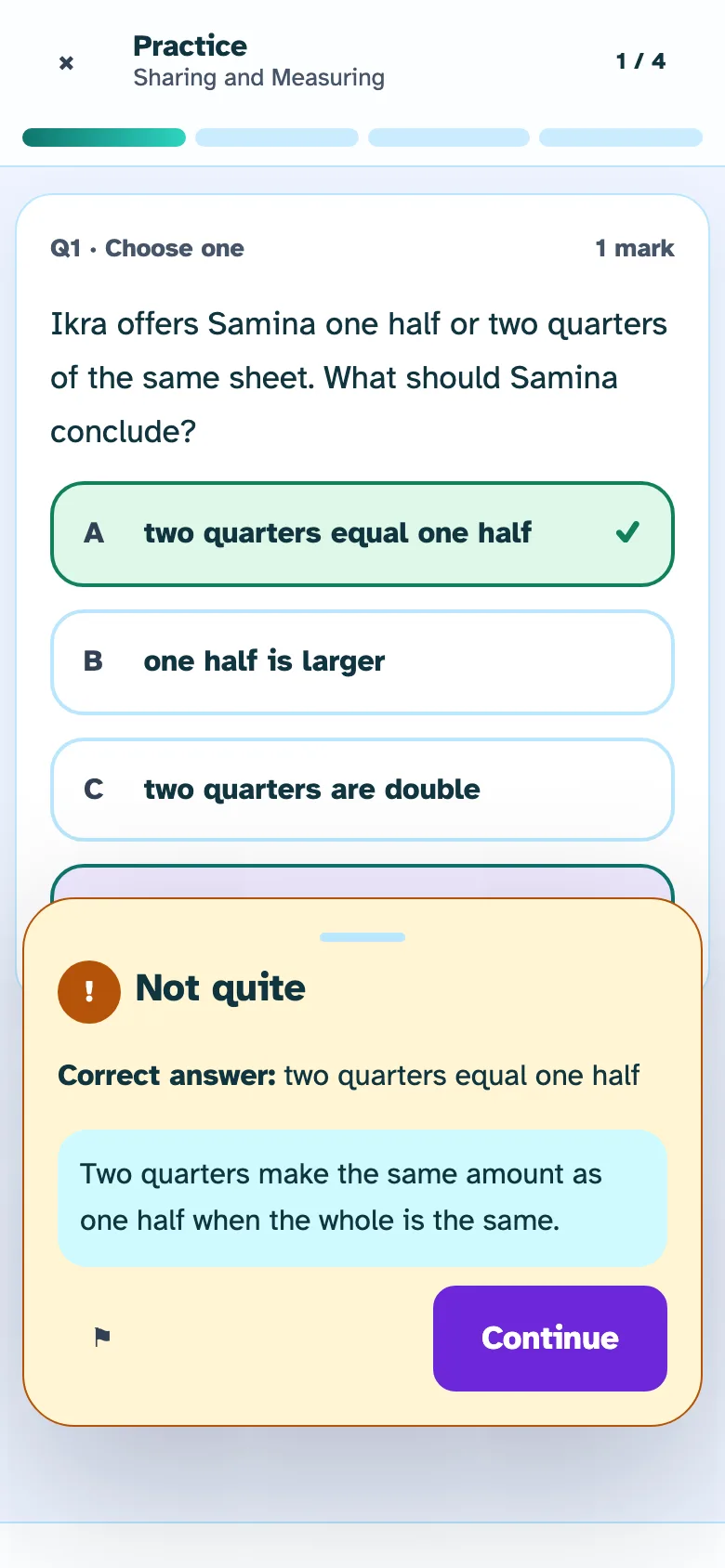
After the lab comes practice, one question at a time. When a child gets a question wrong, the app does not just say "wrong" and move on. It says "Not quite", shows the right answer, and gives a one-line reason.
In the example below, Ikra offers Samina either one half or two quarters of the same sheet, and the child is asked what Samina should conclude. The child picked the wrong option. The screen shows the right one, that two quarters equal one half, and the reason: two quarters make the same amount as one half when the whole is the same.
This is the moment that matters most. A red cross on its own tells a child very little about what to fix, and it can leave them feeling they are bad at maths. A wrong answer with a clear reason teaches them something about fractions. Each practice set has several of these small moments where being wrong turns out to be useful, and we suspect that is a big part of why the children did not mind the practice.
3. Come back later: Fix-it
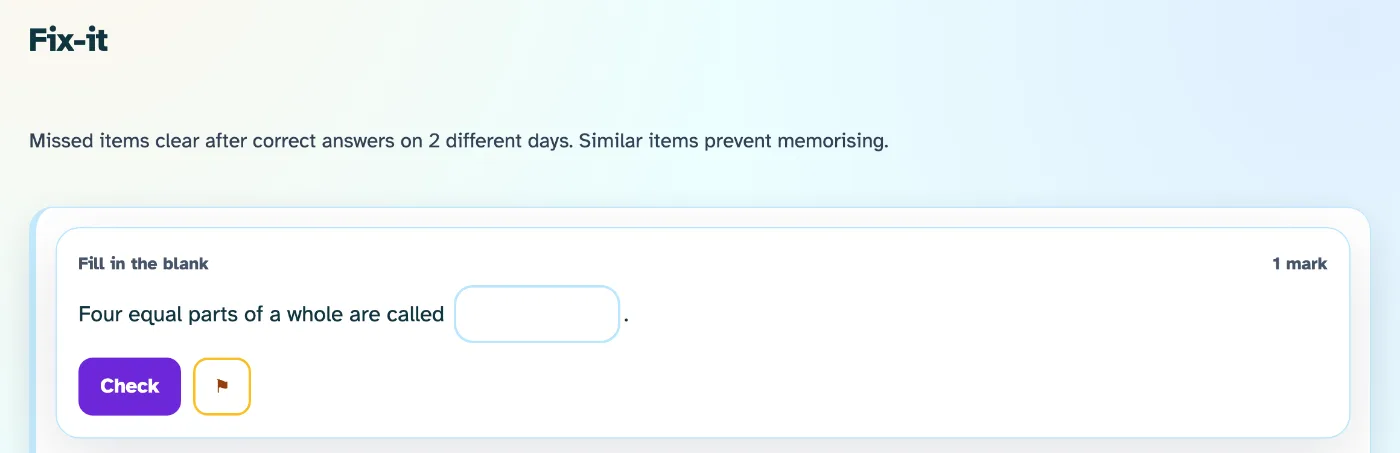
Most of us were taught to revise by reading the chapter again. It feels productive, but it mostly checks whether the page looks familiar. Fix-it works differently. Questions your child misses go into Fix-it and come back later. A question only leaves the list once the child gets it right on two different days, and a wrong answer in between starts the count again. Similar questions on the same idea are mixed in, so a child cannot simply remember the last answer.
Spacing practice out like this is one of the best-studied ideas in learning research, which we come to below. For a child, it also sends a quiet message: a mistake is not the end of the story. It is something you come back to and fix.
4. Mix it up: Quick 5
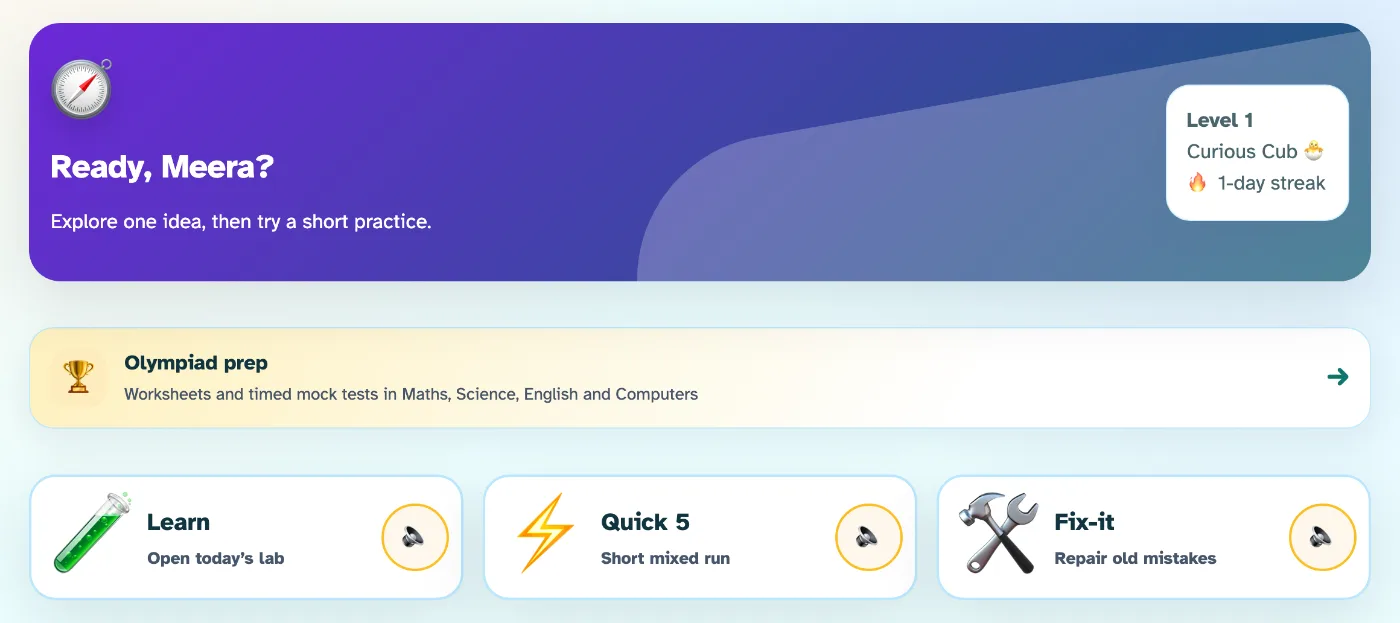
Inside one chapter, children know what is coming. Fractions chapter, fractions question. Class tests and real life are not like that. Quick 5 is a run of five questions mixed from across your child's class, picked by how they have been doing so far. It is short enough for a busy evening, and it makes the child first work out what kind of question it is before solving it, which is a skill of its own.
When a chapter feels done, there are NCERT worksheets that go from easy to challenging, with an answer key. Children can do them on the screen, or you can print one for a pencil-and-paper session, which is still how school exams are written.
The research behind it is old, and it holds up
None of this is our invention. Two well-known pieces of research help explain why this loop works.
In 2006, the psychologists Henry Roediger and Jeffrey Karpicke at Washington University in St. Louis asked university students to read short prose passages and then either read them again or practise recalling them from memory. Their paper, Test-enhanced learning, was published in Psychological Science. On a test five minutes later, the students who re-read did slightly better. A week later the result flipped. In one of their experiments, students who read a passage once and then practised recalling it three times remembered about 61% of it a week later. Students who read it four times remembered about 40%. The re-readers also felt more confident that they would remember, which may be why re-reading is so popular.
In 2013, John Dunlosky and colleagues reviewed the evidence on ten study techniques that students commonly use, in Improving Students' Learning With Effective Learning Techniques. They rated two as high utility: practice testing, and distributed practice, which means spreading practice out over days instead of cramming it into one sitting. Re-reading and highlighting, the two things most children do when they "revise", were rated low utility. Mixing different kinds of problems together, called interleaved practice, was rated moderate, with the clearest evidence in maths.
Practice that asks a child to recall, spread over days, with some mixing: that is the loop above. The evidence is strongest for recall and spacing, and much of it comes from older students, so treat it as a good guide rather than a promise. What our ten families told us is that, when practice is set up this way, children can actually prefer it.
What parents told us, and what we fixed
Parents also told us where things got in the way. Some of the changes below came straight from that feedback and some from our own walkthroughs on phones. We made all of them during those two weeks:
- Sign-up was too long on a phone. Email sign-up is now two short steps, the child's PIN is optional, and the avatar picker is gone.
- The sign-in code email sometimes went to Spam or Promotions. The screen now says where to look, and on phones the Google button fits on the first screen.
- Parents who use Google sign-in could not reset a forgotten parent PIN. There is now a Forgot PIN option that sends a code to the parent's own email.
- On a laptop, the parent menu ran off the bottom of the screen. It now scrolls on its own, so every tab can be reached.
- Parents who arrived from one of our chapter pages had to find that chapter again after signing up. Now a new family that signs up from an English-medium chapter page can usually get that chapter as its free chapter for the subject, in place of the first one.
Small things, but each one was a point where a parent might have given up before their child ever opened a lab.
What this pilot does and does not show
We want to be straight about this, because you deserve better than a big claim from a small trial.
- It was ten families we reached ourselves, not a random sample.
- The result is what parents told us about their child's preference. We did not measure marks or test scores.
- It lasted about two weeks, and almost anything new feels good for two weeks.
- There was no comparison group.
So we are not saying NoTuition.in raises marks, or that it suits every child. Two of the ten parents did not report that preference, and we want to understand why just as much as we want to understand the eight. What we are saying is narrower: when practice was built around trying, checking, understanding mistakes and coming back, most of these parents saw their child prefer it. For building a habit, that is a good place to start.
Five things you can try at home this week
You do not need an app for any of these. They work with a notebook and the NCERT book your child already has.
- Ask before you explain. Before showing how, ask "What do you think?" and let them try, even if the first try is wrong.
- Ask them to teach it back. After homework, ask for one answer explained in their own words, as if to a younger cousin.
- Treat a wrong answer as a clue. Ask "What made that look right?" The reply tells you exactly where the confusion is.
- Come back a few days later. Pick two questions they got wrong this week and ask them again at the weekend, with the book closed.
- Mix old and new. When you quiz them, slip one question from an old chapter in among the new ones.
If you want a simple shape for the time, our guide on making 20 minutes a day count lays out a daily slot, and helping your child with maths at home has more ideas for the subject most families worry about.
Questions parents ask about this
What does learning how to learn mean for a school child?
It means getting better at the process of learning, not only at one topic. In practice that is a set of habits: trying before being told, checking your own answer, finding out why a wrong answer was wrong, going back to a topic a few days later, and coping when the same idea is asked in a new way. Like any habit, it improves with regular practice.
Should my child use AI apps for homework?
They can help a child who is stuck understand an idea. The trouble starts when the app writes the answer, because the child then skips the trying and checking where the learning happens. A simple rule helps: try first, then use the app to check the answer or to understand a mistake.
Does NoTuition.in replace the NCERT book?
No. It follows the NCERT book your child uses at school, chapter by chapter, in the same order. The book and the classroom come first. The labs, practice and worksheets help your child go over the same chapter at home.
How much time does it take each day?
There is no fixed amount. A lab or a short practice set fits into about twenty minutes. Short sessions spread across the week also fit the research on spaced practice better than one long session at the weekend.
Is NoTuition.in free to try?
Yes. The free plan opens one full chapter in every subject, with its lab, practice and a worksheet. No card is needed.
Sources
- World Economic Forum (2025). The Future of Jobs Report 2025.
- Ministry of Human Resource Development, Government of India (2020). National Education Policy 2020, Introduction.
- Roediger, H. L., and Karpicke, J. D. (2006). Test-enhanced learning: Taking memory tests improves long-term retention. Psychological Science, 17(3), 249-255.
- Dunlosky, J., Rawson, K. A., Marsh, E. J., Nathan, M. J., and Willingham, D. T. (2013). Improving students' learning with effective learning techniques. Psychological Science in the Public Interest, 14(1), 4-58.